
Seed in the dry weeks, cover before the rain
Hydroseeding in Portland, OR
New lawns, slope cover, silt fence and soil prep, scheduled around a wet winter and an almost rainless August.
- No-cost site visit, then a quote in writing
- Seeding planned around the Willamette Valley rain calendar
- Silt fence and stabilization installed to your approved erosion plan
What Portland Ground Asks of a New Lawn
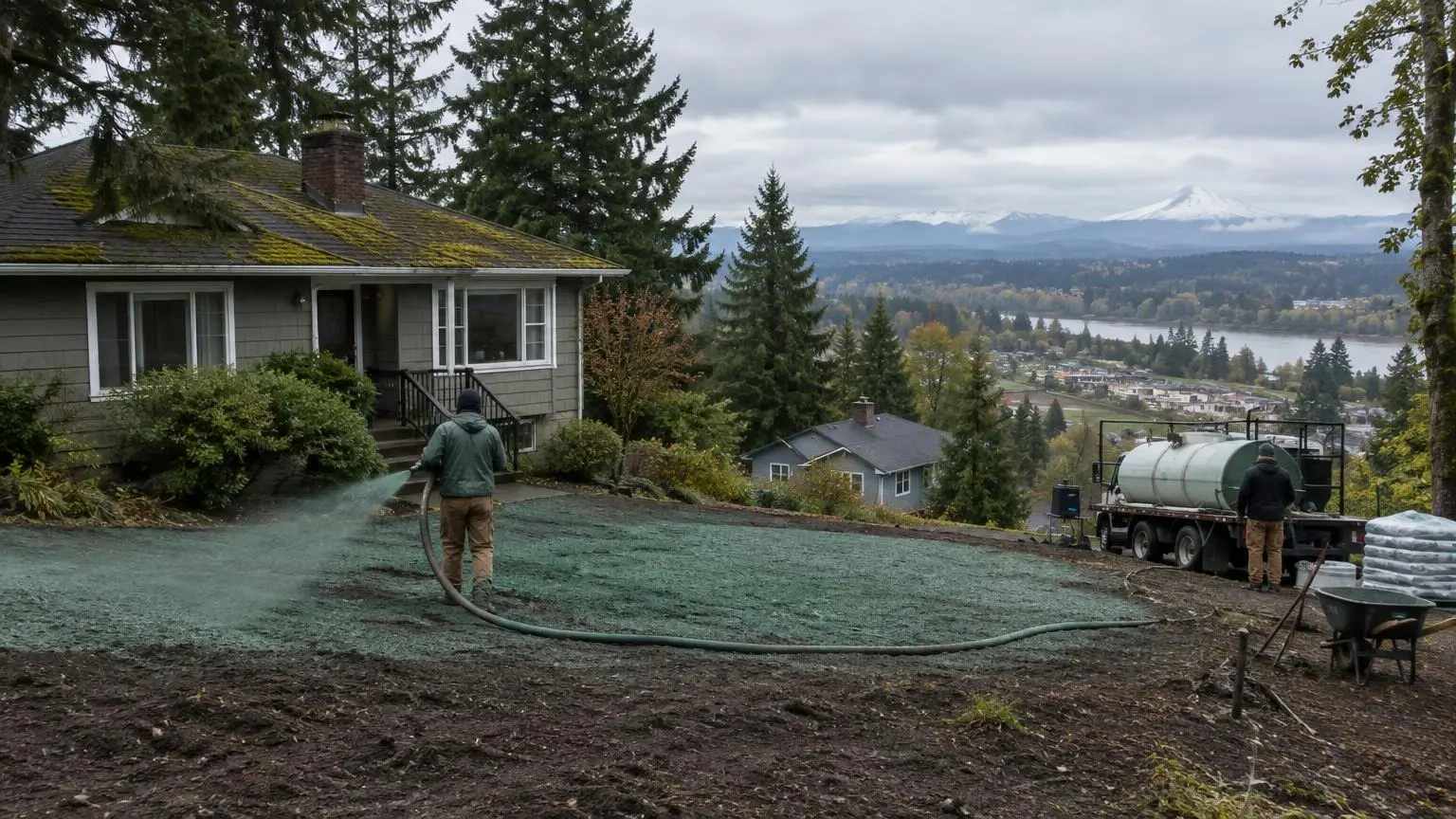
Hydroseeding in Portland works well because the climate is kind to cool-season grass, but it rewards anyone who respects the calendar. The city sits at the north end of the Willamette Valley where the Willamette meets the Columbia, with a warm-summer Mediterranean climate: cool, rainy winters and warm, dry summers. We spray seed, fiber mulch, fertilizer and tackifier in one pass for new lawns, construction sites and bare slopes across the city, then back it up with the erosion control, silt fence and grading work that Portland jobs usually need.
Two seasons that matter
Rain is not the problem here; the timing of it is. The 1991-2020 normals at Portland International Airport show 5.45 inches in November and 5.77 inches in December, but only 0.51 inches in July and 0.54 inches in August. The sunny warm stretch is short, from about mid-June to early September, and the average freeze window runs from November 15 to March 19, which leaves a growing season of roughly 240 days.
Oregon State University Extension's lawn guide for the Willamette Valley names August 15 to September 15 as the fall optimum for seeding. Days are still warm, nights are cooling, and the lawn has six to eight weeks of growing weather before the rains settle in. Early May to about mid-June is the second window. Seed sown after mid-October tends to come up thin and weedy, and OSU advises adding 2 pounds of seed per 1,000 square feet for every week past mid-September if you have to push it late.
Hydroseed, sod or dry seed?
All three can produce a good lawn in western Oregon. OSU Extension notes that seeding stayed the standard method here, even as sod spread nationally, because seeded lawns establish so easily in this climate. Sod gives you grass the day it goes down and can be laid in western Oregon from about mid-March through mid-November, but it costs several times more per square foot. Dry seed is the cheapest, but it blows, washes and feeds birds.
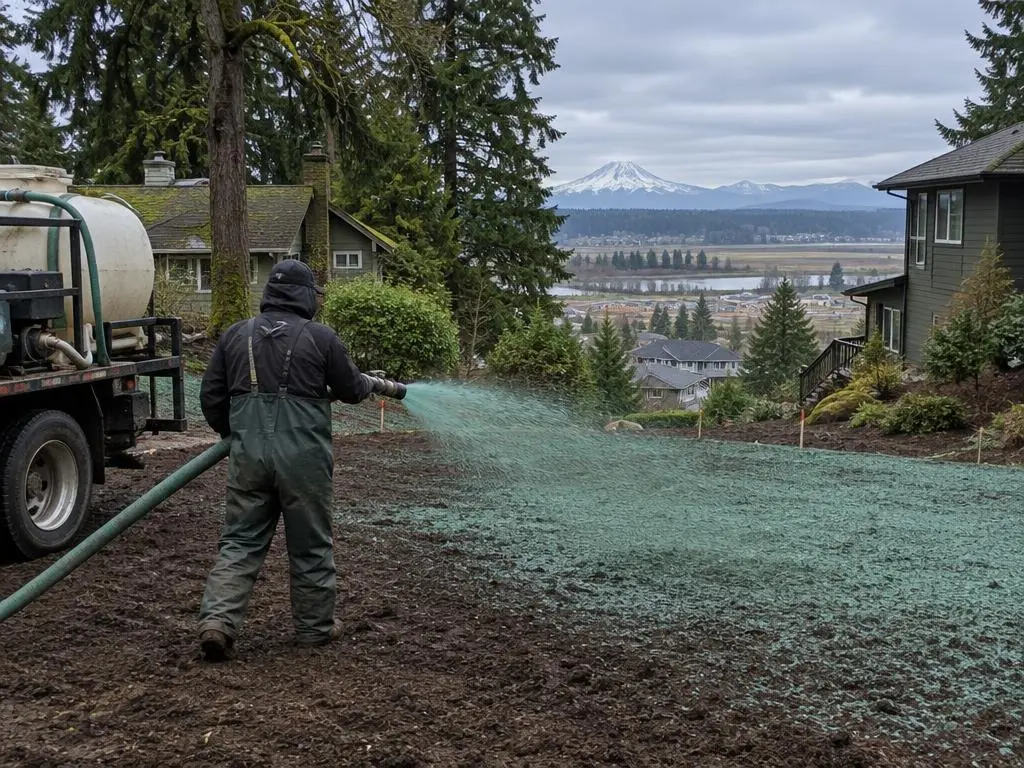
Hydroseeding sits between them on price. The fiber mulch holds moisture against the seed, the tackifier keeps the slurry in place on a slope or a windy lot, and the hose reaches side yards and banks a sod pallet never will. OSU is also frank that over the long run a well-watered dry-seeded lawn and a well-watered hydroseeded lawn end up much the same. The difference is in the first month, and on hillsides, where mulch that stays put is the whole point.
What the soil looks like
Much of the ground along the Columbia in Multnomah County is Latourell loam, a series first described in Multnomah County in 1977. The USDA describes it as a dark brown, well drained loam on broad terraces from 50 to 400 feet in elevation, mostly on slopes under 8 percent but up to 30 percent on terrace fronts and along drainageways. It is acidic near the surface, and in a normal year the layer from 4 to 12 inches deep stays dry for 45 to 80 days straight after the summer solstice. That last fact is why a spring-seeded lawn on this kind of soil needs a real irrigation plan for July and August.
Not every lot has soil like that. Neighboring Powell soils are somewhat poorly drained and carry a fragipan, and OSU describes typical Willamette Valley lawn soil as silty clay or clay loam with a pH around 6.0. New construction often leaves subsoil and excavation spoils instead of topsoil. We dig a few test holes on every site visit so the seedbed plan matches what is actually there.
Hills, cinder cones and flood deposits
Downtown and the east side are mostly flat; the east side runs roughly 180 blocks to Gresham. The West Hills, the foothills of the Tualatin Mountains, rise through the northwest and southwest of the city, and Council Crest Park is often quoted as the high point at 1,073 feet. East of the river, Mount Tabor is a 636-foot cinder cone, one of at least 32 in the Boring Lava Field that lies under the city. During the last ice age, the Missoula Floods filled the Willamette Valley with 300 to 400 feet of water.
That mix means a short drive can take us from a flat east side bungalow lot to a hillside cut where plain hydromulch will not hold through November. On slopes we move up to a bonded fiber matrix or a straw or coir erosion control blanket and break long runs with wattles.
Portland's erosion control rules
The city runs its construction stormwater program under an NPDES MS4 permit from the Oregon Department of Environmental Quality, carried out through City Code Title 10 and the Erosion and Sediment Control Manual. Sediment is not allowed to leave a site or reach a storm inlet, functioning inlets have to be protected, and bare development ground has to be stabilized within two days of disturbance from October 1 to April 30 and within seven days from May 1 to September 30. Projects that do not need a permit still have to meet the same basic performance standards.
For builders, that turns hydroseeding into a compliance tool as much as a lawn. Few methods get a finished pad or a backfilled utility trench covered faster than a pass of seed and tackified mulch ahead of the inspector's next visit, and silt fence or wattles below the work keep soil out of the street while it grows in.
Picking the grass
Whether it is hydro seeding or dry seeding, the grass choice matters more than the method. Portland is in USDA hardiness zone 8b, with parts of downtown in 9a, and the lawns here are cool-season grasses. For most yards west of the Cascades, OSU Extension suggests a perennial ryegrass or fine fescue base with some colonial bentgrass, since bentgrass tends to move into Portland-area lawns on its own anyway. Shady lots under Douglas-fir do better with more fine fescue; high-traffic yards lean on perennial ryegrass. We tell you what is in the tank before we spray it.
Getting a price
Every job starts with a free site visit. We measure the area, check slope and drainage, look at how far the hose has to reach, and note any permit or erosion plan you are working under. You get a written estimate that separates soil prep, seeding, mulch and any silt fence or blankets. Get a free estimate
Neighborhoods, Suburbs and Clark County Towns We Cover
We work across Portland on both sides of the Willamette and out through Multnomah, Washington and Clackamas counties. To the east that means Gresham, Fairview, Troutdale and up the Sandy River to Sandy. On the west side we cover Beaverton, Hillsboro, Forest Grove and Cornelius, out on flat Tualatin Valley farm ground. South of the city, Tigard, Tualatin, Sherwood, Lake Oswego, West Linn, Milwaukie, Happy Valley, Oregon City, Wilsonville and Canby run from lakefront and bluff lots to river bottoms and new subdivisions. Across the Columbia we seed in Vancouver, Camas, Washougal, Battle Ground and Ridgefield. Hillside towns need more slope protection, valley towns need more drainage work, and each town page explains what we watch for there.
- Hydroseeding in Portland, OR
- Hydroseeding in Gresham, OR
- Hydroseeding in Hillsboro, OR
- Hydroseeding in Beaverton, OR
- Hydroseeding in Happy Valley, OR
- Hydroseeding in Tigard, OR
- Hydroseeding in Lake Oswego, OR
- Hydroseeding in West Linn, OR
- Hydroseeding in Oregon City, OR
- Hydroseeding in Tualatin, OR
- Hydroseeding in Sherwood, OR
- Hydroseeding in Wilsonville, OR
- Hydroseeding in Milwaukie, OR
- Hydroseeding in Troutdale, OR
- Hydroseeding in Fairview, OR
- Hydroseeding in Camas, WA
- Hydroseeding in Washougal, WA
- Hydroseeding in Battle Ground, WA
- Hydroseeding in Ridgefield, WA
- Hydroseeding in Vancouver, WA
- Hydroseeding in Canby, OR
- Hydroseeding in Forest Grove, OR
- Hydroseeding in Cornelius, OR
- Hydroseeding in Sandy, OR
Common Questions
Is hydroseeding worth the money in Portland?
For most new lawns and almost all slopes, yes. It usually costs well under sod and more than dry seed, and the mulch and tackifier keep seed in place through rain and wind. On a small, flat, sheltered patch that you can water carefully, raking in dry seed can do just as well.
What type of grass is best for a lawn in Portland, Oregon?
Cool-season grasses. For most western Oregon yards OSU Extension suggests a perennial ryegrass or fine fescue base with colonial bentgrass, more fine fescue for shade, and more perennial ryegrass for heavy wear. Tall fescue is better suited to hotter parts of the state.
Which months give hydroseed in Portland the strongest start?
Mid-August to mid-September is the strongest window, followed by early May to mid-June. Seeding after mid-October usually gives a thin, weedy stand, so late-season jobs are better treated as erosion cover with a lawn finish in spring.
How long until I can mow a new hydroseeded lawn?
In good fall or spring weather, perennial ryegrass shows green in about 7 to 10 days, and OSU says many seeded lawns need their first mowing about three weeks after planting. Slower grasses, cool weather and shade stretch that out.
How much watering does fresh hydroseed need during a Portland summer?
Keep the surface damp, not soaked: two to four short waterings a day until it sprouts, then taper to once a day by the end of the second week and every few days after that. In July and August the rain will not do it for you.
Will hydroseed hold on a West Hills slope over winter?
Plain fiber mulch often slides on a steep cut once the November rain arrives. Steeper West Hills ground gets either a bonded fiber matrix spray or pinned erosion control blankets, with wattles or silt fence below, and seed early enough that roots are in before the wettest months if we can.
Do I need an erosion control permit to reseed my yard?
Landscaping that does not need a development permit is generally exempt from the city's permit and signage steps, but sediment still is not allowed to wash into the street or storm drains. If your seeding is part of a permitted build, the approved erosion plan governs.
Our Services
Hydroseeding services and the site work around them: six kinds of work that get bare Portland ground growing and keep it in place through the rainy season.
Home Lawn Hydroseeding
New lawns sprayed onto prepared soil for new houses, remodels and yards starting over from bare ground.
Learn more →Developer & Commercial Hydroseeding
Broad-area seeding for subdivisions, commercial pads, utility corridors and public projects.
Learn more →Wet-Season Erosion Control
Wood-fiber hydromulch, BFM, pinned straw or coir blankets and wattles to keep Portland slopes in place through the wet months.
Learn more →Silt Fence, Wattles & Inlet Protection
Perimeter sediment control and storm inlet protection installed before digging and maintained until the ground is green.
Learn more →Grading, Topsoil & Seedbed Prep
Yard grading, topsoil, fine grading and the rest of the soil prep a lawn needs before seeding.
Learn more →Lawn Repair & Fall Overseeding
Thin, patchy and worn Portland lawns brought back by renovation, aeration and overseeding.
Learn more →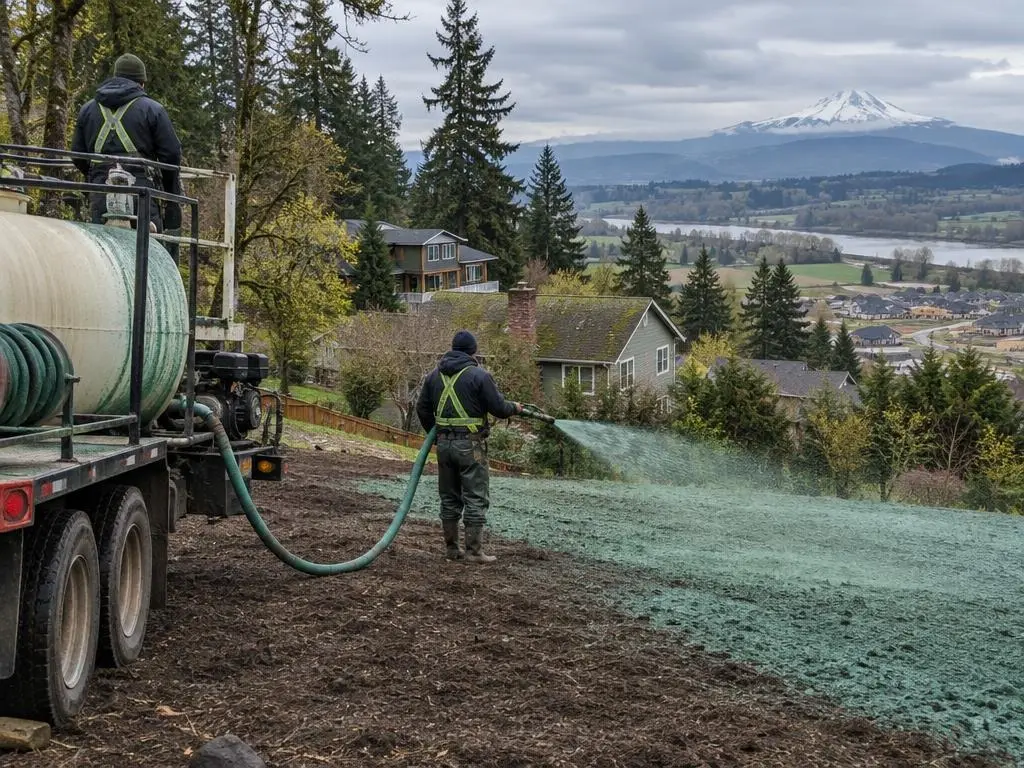
Why Homeowners Call Hydroseeding Portland
Timed to the valley calendar
We push lawn seeding into the mid-August to mid-September window and the May to mid-June window, and tell you plainly when it is too late in the fall to expect a clean stand.
Cover matched to the slope
Flat yards get standard fiber mulch; West Hills cuts, butte lots and creek banks get bonded fiber matrix or blankets.
Built for Title 10 sites
We know the two-day and seven-day stabilization deadlines and install the silt fence, wattles and inlet protection shown on your plan.
Soil checked, not assumed
Test holes on the site visit tell us whether you have loam, clay, spoils or thin soil over gravel before we price topsoil or grading.
Book a Site Visit Before the Rains Return
Free walk-throughs and written estimates across Portland and Clark County.