
Wetter hills, fast growth
Hydroseeding in Happy Valley, OR
An extinct volcano, a lot of new houses and about 48 inches of rain a year.
- No-cost site visit, then a quote in writing
- Seeding planned around the Willamette Valley rain calendar
- Silt fence and stabilization installed to your approved erosion plan
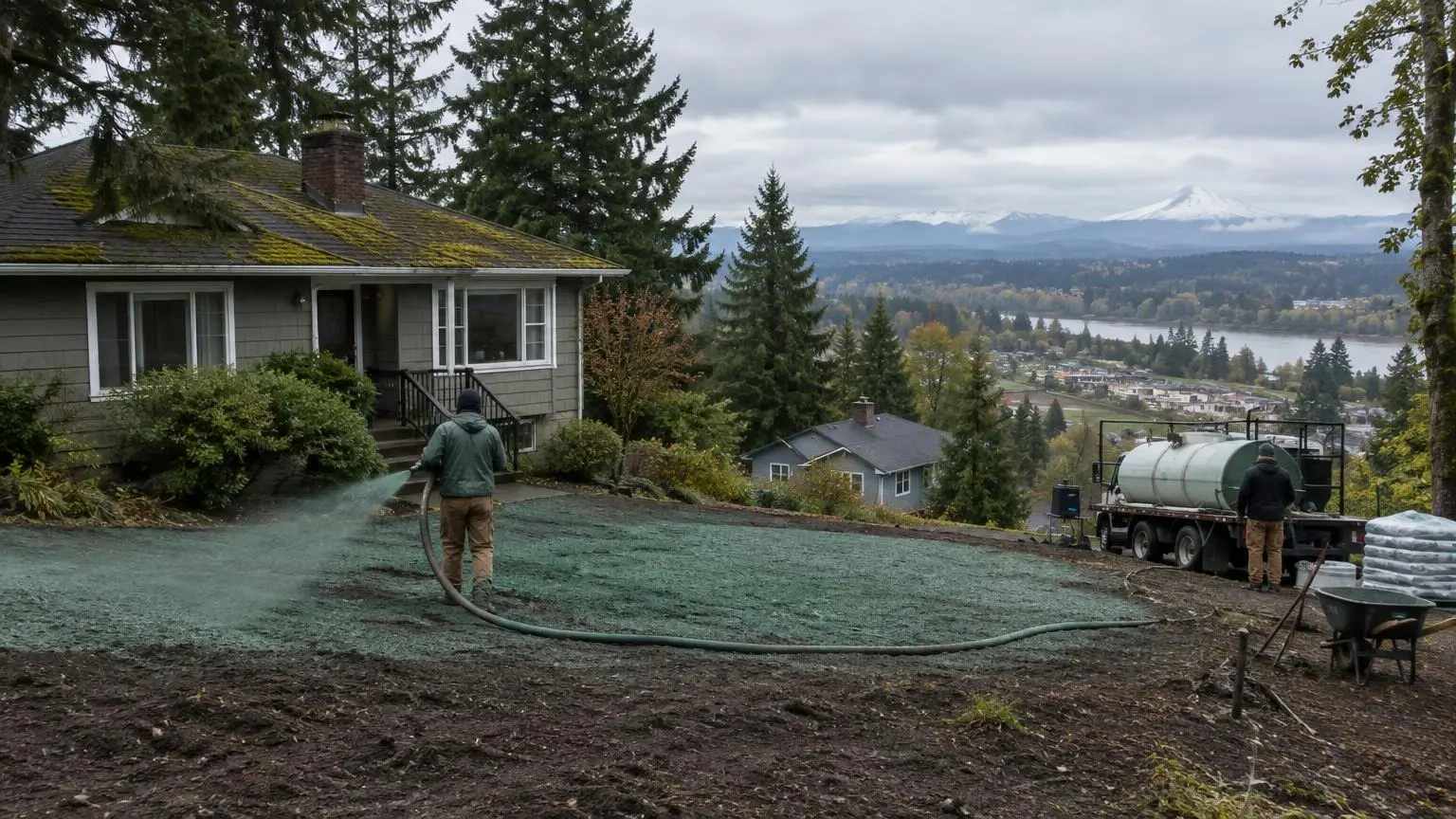
New Lawns on Happy Valley Hillsides
Hydroseeding in Happy Valley usually means seeding on a slope. The city's high point is Mount Scott, an extinct volcano in the Boring Lava Field that reaches 1,050 feet, and Scouters Mountain is another prominent hill. Happy Valley stayed a small community until the late 1990s, when it became one of the fastest-growing cities in Oregon, and much of that growth went onto these hillsides.
More rain than the valley floor
Happy Valley has a recorded average of about 48 inches of rain a year, well above the roughly 37 inches at Portland's airport. That helps seed sprout in fall and spring but raises the stakes for bare ground. A graded lot left open over winter can lose a lot of topsoil before anyone notices.
Erodible volcanic soils
The Johnson Creek watershed record singles out soils around Powell Butte and the Boring Lava Domes as having an extremely high erodibility factor and being sensitive to ground disturbance. On new lots near those buttes we cover the ground soon after grading: hydromulch with a strong tackifier on gentle ground, bonded fiber matrix or blankets on steeper cuts and fills.
Silt fence on the downhill side
Runoff from a hillside lot heads straight for the street below or the neighbor's yard. Before spraying, we run silt fence across the bottom of the lot, protect nearby inlets, and leave it in place until the grass has rooted.
Drainage to Johnson Creek
In 2000, Johnson Creek and its tributaries drained about 19 percent of Happy Valley. Keeping sediment on the lot protects those small streams as well as your own topsoil.
Get a free estimate or call (971) 588-2069 for a slope or new-construction lawn in Happy Valley.
Happy Valley Hills and Rain
- Mount Scott. Mount Scott, an extinct volcano in the Boring Lava Field, is the city's highest point at 1,050 ft.
- Rainfall. Happy Valley has a recorded average annual rainfall of about 48 inches.
- Erodible soils. Soils around Powell Butte and the Boring Lava Domes have an extremely high erodibility factor and are sensitive to disturbance.
- Late-1990s boom. The city stayed small until the late 1990s, then became one of Oregon's fastest-growing cities.
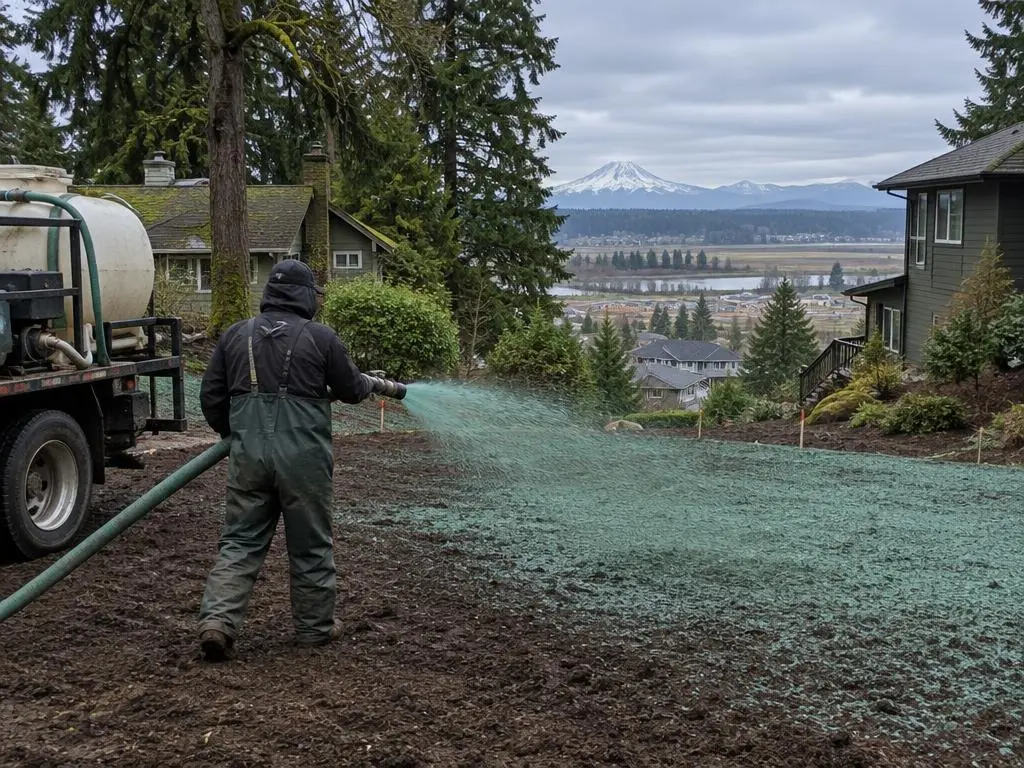
Happy Valley Questions
How fast should a freshly graded lot be covered?
As soon as grading is finished. On erodible hillside soil we like to seed and mulch within days, not weeks.
Is hydromulch enough on a cut slope?
On gentle grades it can be. On steeper cut or fill slopes we use bonded fiber matrix or blankets.
With all that rain, will I ever need to water?
Fall and spring rain do most of the work, but a lawn seeded in late spring still needs water through summer.
Who handles silt fence on a single-lot build?
We can install and maintain it along the low edge, then pull it once the grass holds.
Free Estimates in Happy Valley, OR
Site visits on Happy Valley's hillsides and new streets.
Hydroseeding Near Happy Valley
- Hydroseeding in Portland, OR
- Hydroseeding in Gresham, OR
- Hydroseeding in Hillsboro, OR
- Hydroseeding in Beaverton, OR
- Hydroseeding in Tigard, OR
- Hydroseeding in Lake Oswego, OR
- Hydroseeding in West Linn, OR
- Hydroseeding in Oregon City, OR
- Hydroseeding in Tualatin, OR
- Hydroseeding in Sherwood, OR
- Hydroseeding in Wilsonville, OR
- Hydroseeding in Milwaukie, OR
- Hydroseeding in Troutdale, OR
- Hydroseeding in Fairview, OR
- Hydroseeding in Camas, WA
- Hydroseeding in Washougal, WA
- Hydroseeding in Battle Ground, WA
- Hydroseeding in Ridgefield, WA
- Hydroseeding in Vancouver, WA
- Hydroseeding in Canby, OR
- Hydroseeding in Forest Grove, OR
- Hydroseeding in Cornelius, OR
- Hydroseeding in Sandy, OR